
Helpful Information on South Korea
By Gillian Boyd Published 25 March 2026
This post contains helpful information on travel in South Korea including public holidays, transport, payment cards, customs and useful apps.
Republic of Korea
We visited South Korea which is officially known as the Republic of Korea (ROK) for two weeks. In these posts when I refer to Korea, I mean the Republic of Korea. We did not visit North Korea, the Democratic People’s Republic of Korea (DPRK)….or maybe we put one foot inside.
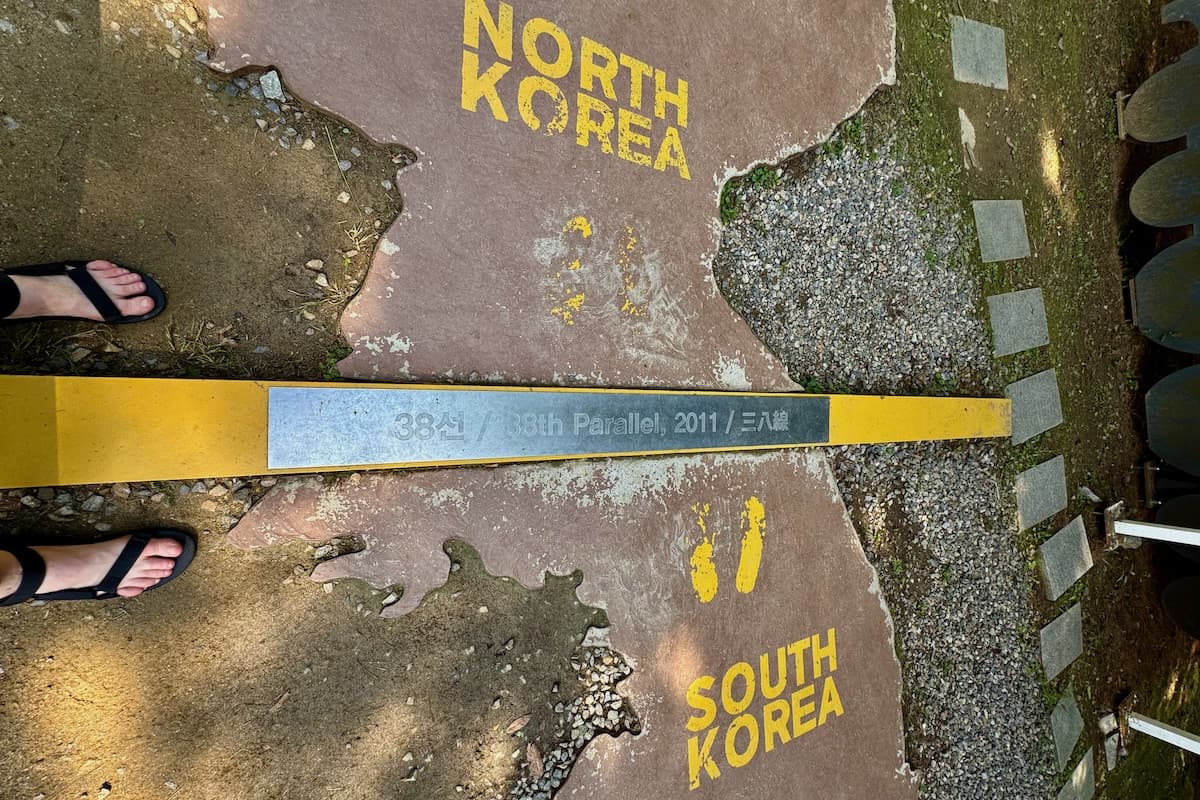
38th Parallel – one foot inside North Korea
Important Public Holidays
It is always useful to be aware of important public holidays in your planning as they can affect transport, accommodation, opening hours, crowds and festivals that you may want to join in.
Korea’s most important public holidays are Seollal, Lunar New Year’s Day and Chuseok, Korean Thanksgiving Day. The dates vary each year.
In 2026, Seollal falls on 17 February, which like this year, is almost always the first day of the Chinese New Year. The celebrations usually last 3 days including the eve of the Lunar New Year, the day itself and the day after the new year.
In 2026, Chuseok, Korean Thanksgiving Day, is a public holiday lasting from 24 September to 26 September, but many Koreans take off the entire week.
Rail Bookings at Chuseok – Our Experience
Our trip to Korea coincided with Chuseok and this had major implications for transport as many Koreans travel home to spend time with their families. Korea operates an excellent high speed national rail service , but closes all bookings for the entire Chuseok week.
You need to register online and then on the Release Date, the option to book tickets becomes available to veterans, disabled and citizens of honour only.
The following day, the option to book trains is open to citizens of Korea.
On the third day the option to book trains is open to everyone including international tourists (who are redirected to the overseas booking platform of KORAIL) but by then all the primary rail links are fully booked and nothing is available.
Other Options
The alternative is to take a bus or fly. The traffic over the holiday period effectively means buses should be a last resort, so book your flight early as this is in demand too. That is exactly what we had to do, as we could not get back from Busan or Gyeongju to Seoul by train.
If you are not travelling between cities then the public holiday should have little impact on your visit. Outside of public holidays train tickets can also be booked on Trip.com.
Pre-Order SIM
Before travelling, we pre-ordered a 20 day data only SIM and chargeable travel card from Get Your Guide with pick-up from LG U+ Counter at Gate A of Terminal 1. It included a chargeable top-up transportation card called a Tmoney card for trains and buses.
We consider it very important for one of us to have access to data and mobile connection as soon as we can when we enter a new country. Typically, we try to purchase different networks to maximise our coverage across the country. Depending upon the price and number of days in the package deals, often one of us is without coverage for a day or two at either end of the trip.
Getting From Seoul Incheon International Airport
1. Arex Train
The Arex Train runs about every 40 minutes and departs from the basement of the airport. The Arex Train goes direct to Seoul Station in the city centre in 1 hour and then you can transfer to the various metro lines.
2. Airport Limousine Buses
We took Airport Limousine Bus 6001 as our hostel advised it was the quickest and most straightforward route for us. Bus 6001 ran about every 15 or so minutes and was very comfortable with only 3 seats across. In fact, it was so comfortable I kept nodding off.
Tickets for the limousine buses can be bought from a machine at the airport or from the bus ticket office inside the terminal. Pre-recorded messages in English and Korean announced the next bus stop making it easy to get off at the correct place.
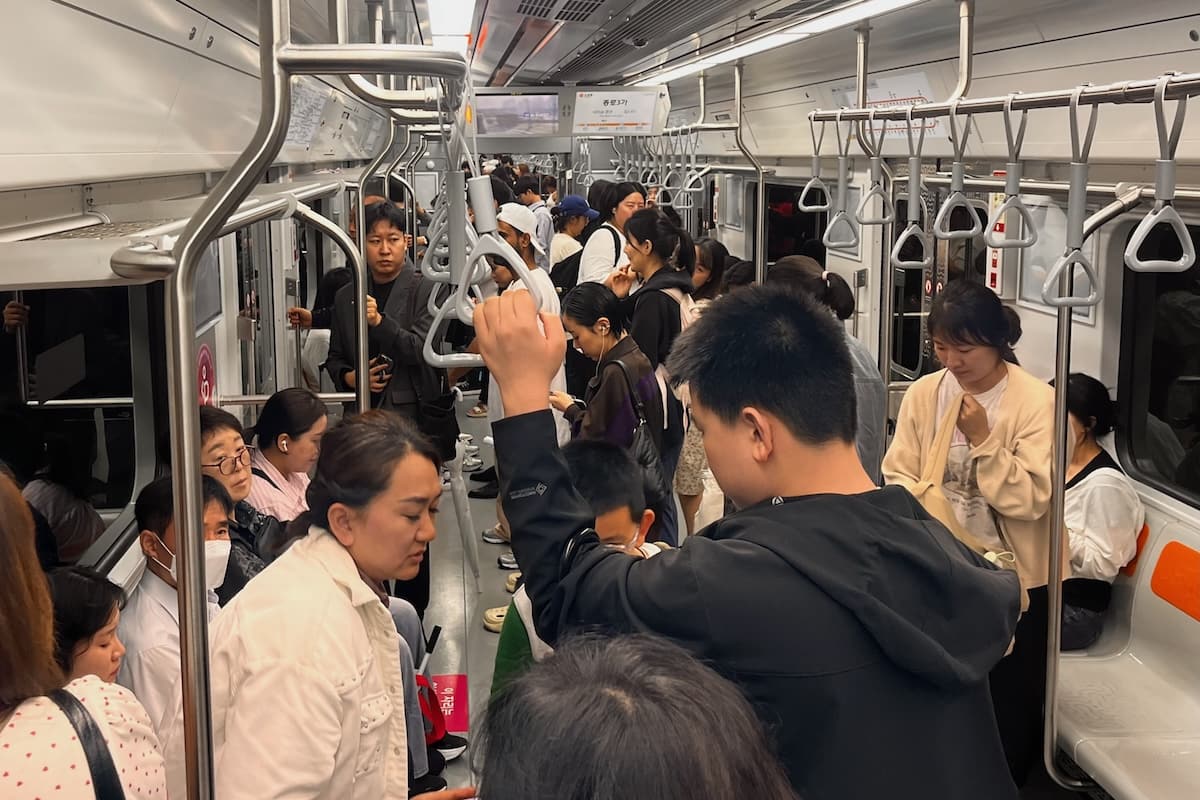
Crowded Seoul Metro carriage
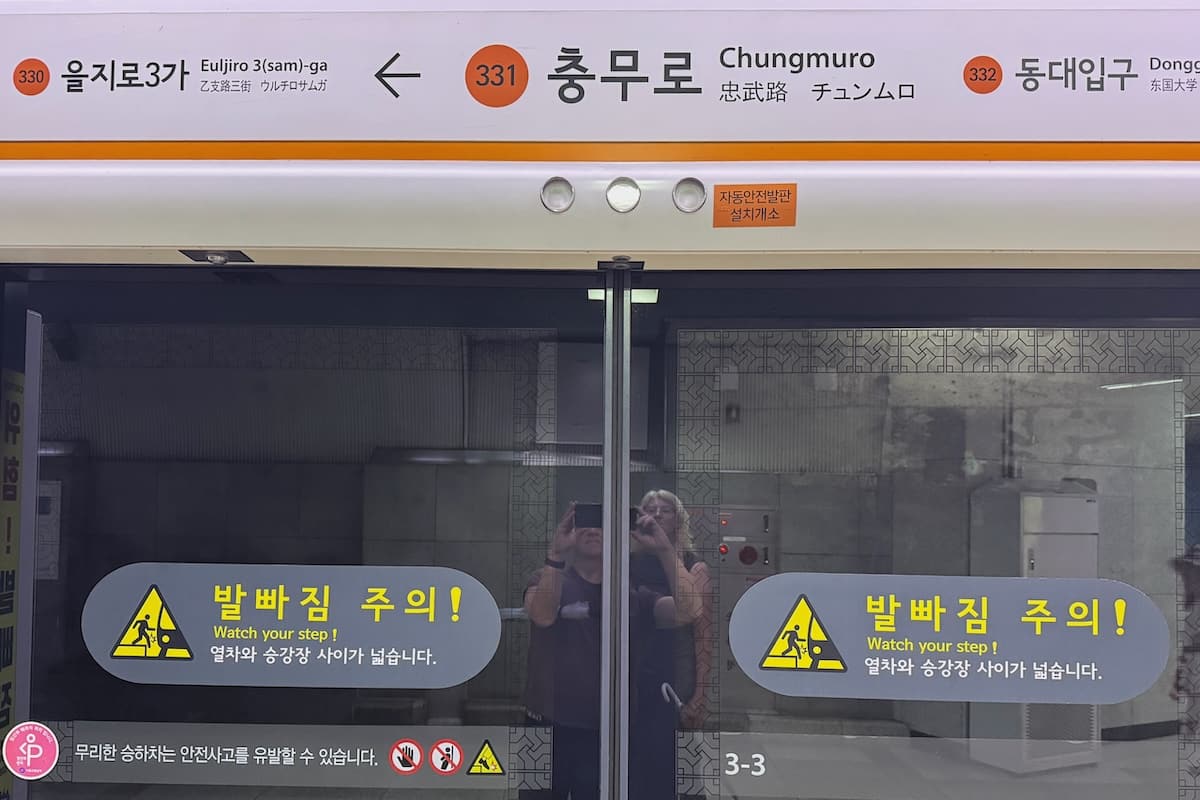
Seoul Metro signage on platform
Seoul Metro
The Seoul metro system is fast, clean and efficient. It is like many metros worldwide and easy to use. At the metro station, the stops and much of the signage are in Korean and English. The lines are colour coded and numbered with plenty of maps on the subway walls. The signs show the next stop in the direction of travel so it is easy to understand.
Public buses and metros are very clean with hard plastic seats. They are efficient and easy to understand with announcements of the next stop in English as well as Korean. Electronic boards at bus stops tell you how long until the next bus arrives. It is the same on the metro.
Payment
You need a transport card to make payment on buses and metro as it is not possible to pay with debit or credit cards and they don’t carry cash. The transport card is used to tap in and out and can be bought at convenience stores or in the metro station. It was very easy. There are 2 types of transport card.
1. Tmoney Card
The Tmoney Card is the basic transport card and is a pay as you go system. You pre-load the card (at convenience store or in metro) with credit and then pay for each journey. The Tmoney Card can be topped up in the same way.
We used Tmoney when outside Seoul. The Tmoney card can only be purchased or topped up using cash. You can also use the card for paying for items in convenience stores.
2. Climate Card
The Climate Card is a transport card giving unlimited travel for a set number of days on the buses and metro in Seoul. It comes in 1, 2 or 5 day options. The Climate Card only operates in Seoul.
We bought a Climate card for 5 days which fitted perfectly with our length of stay in Seoul. We bought ours with cash from a machine in the subway and a member of staff immediately came over to help us.
With the Climate Card we just hopped on and off the metro and buses as we felt like and as we were using them frequently it was cheaper than paying for individual journeys using Tmoney.
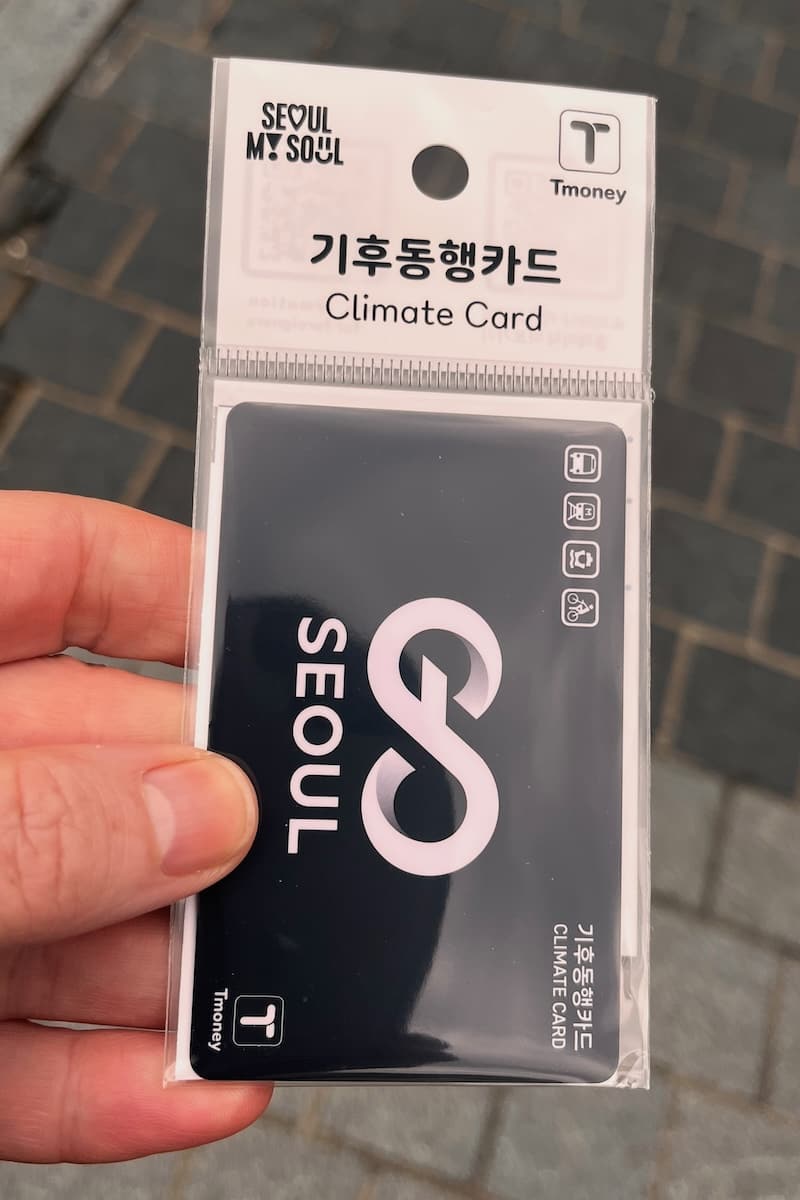
Climate Card for unlimited travel on Seoul Metro and buses
Useful Apps in South Korea
We found these free apps very useful in South Korea:
Subway – good Seoul metro map app for your phone.
City mapper – useful travel planning tool linking all public transport for Seoul and many other major cities worldwide like London and Tokyo.
Naver – maps in English and Korean. We found it to be more accurate than Google maps or Apple maps in Korea. If you have a hire car, then it is worthwhile to set up the notifications with sound to warn you of the speed limit changes, especially in Jeju. Speed limits change frequently due to Child Protection Zones and Senior Protection Zones. It is easy to get caught out when driving unfamiliar roads especially as the limits apply all the time, even late on a Sunday night when no one is about. We met several tourists who got speeding fines, but we were lucky to avoid them.
Buses
Korean buses leave promptly on time. Even at the end of the line, they turn around and leave immediately. Buses do not carry cash so you must have exact amount or use a TMoney Card which can be charged up with cash at most convenience stores.
Remember to tap in and out of the bus (unlike me who kept forgetting!) When you tap in look at the balance left on your card to help you keep track.
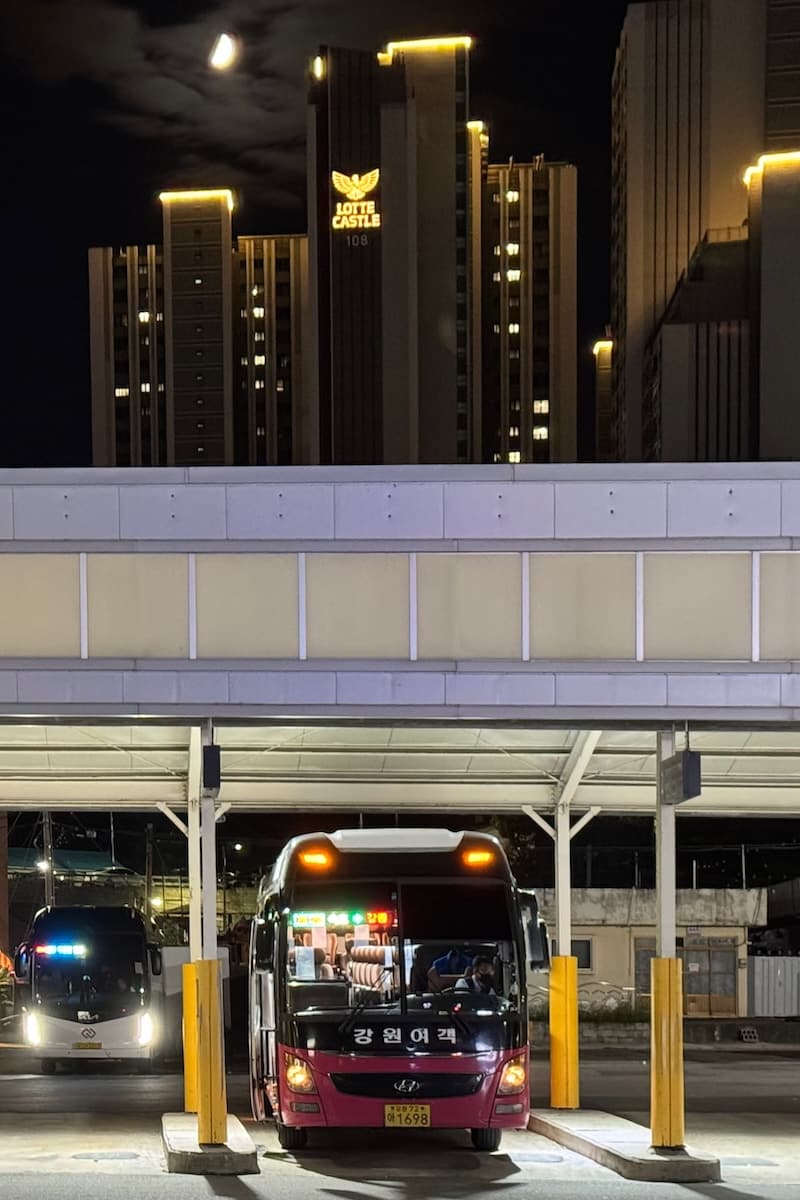
Sokcho Bus Station
Pedestrian Crossings
Pedestrian crossings have a countdown and Koreans ALWAYS wait for lights. No jaywalking, even when there are no cars in sight.
Do not press the button as this is not to change the lights, but is for blind people and it talks to you in Korean.
The pedestrian lights are on a set pattern with no method to alert that you are waiting. On occasions we waited four mins for the lights to change. We noticed that some zebra crossings do not have lights, so we tried to use those instead, which was especially important when carrying our backpacks on the way to bus station. When leaving the hostel for a bus, we factored in extra time for waiting at crossings.
Koreans are Very Helpful
We found Koreans to be very helpful, friendly and polite. A number of times when we looked confused and were in the process of figuring it out, a local would speak to us in English and help us use the machine, point out where the bathroom was, take us to the right train or subway platform or show us the local customs such as finding the drawer in the restaurant table with the napkins and chopsticks. Sometimes they gave me a fork as my technique with metal chop sticks is poor as metal chopsticks have less grip than wooden chopsticks.
Say Kimchi
When getting a photo taken, Koreans say kimchi, which makes sense as your mouth ends in a smile when saying the word, just like saying cheese in English. Try it and you’ll see what I mean.
CCTV
There are CCTV cameras everywhere in the streets and even up near the top of peaks in Bukasan National Park and Seroakan National Park. We felt very safe.
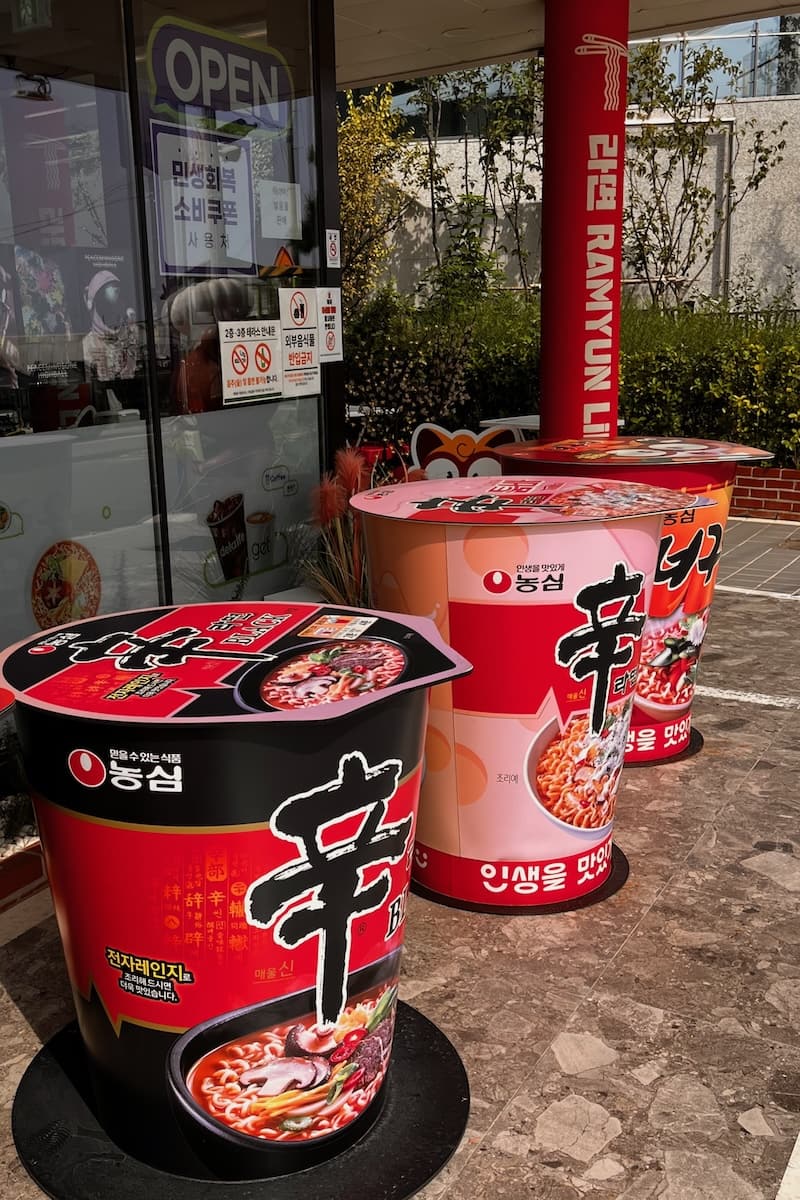
Convenience Store in Korea with tables outside
Convenience Stores
Convenience stores are very common and plentiful in Korea. They stay open late and you can heat up your food in their microwaves. Often, they have a few tables for eating. Sometimes inside, sometimes outside. It’s also where you can buy or top up your Tmoney Card.
Clean and Good Food Hygiene
Water is safe to drink. Korea feels very safe and clean. The standard of infrastructure is very high. The streets are clean and well maintained. No pot holes here!
Toilets
We found toilets to be widely available. Every toilet had paper though sometimes it was outside the cubicle. Only once, was there no soap. The toilets were always clean, even those up the mountain and did not smell even though the toilet paper was placed in a bin, not flushed in the toilet.
Clothes
Many women, especially young Korean women in Seoul wear shorts or short skirts. Clothes tend to be modest, loose and in plain neutral colours like black, white and grey.
Outside of hiking clothes, it is rare to see bright colours. Denim jeans are becoming more popular among the young in the big cities. Leggings are rare and only worn for exercise.
When hiking at the end of September in roughly 22C, Koreans wear full hiking kit of trousers, long sleeved top, wide hat with chin strap, snood, gloves, hiking boots, poles, rucksack and sometimes full face covering. The tourists like us hiked in trainers, shorts, t-shirt (usually a sports one), small drawstring gym bag or rucksack and a baseball cap.
Laundry is very easy and cheap in South Korea. Almost all hostels and hotels have self-service laundry facilities available on premises at a very reasonable price.
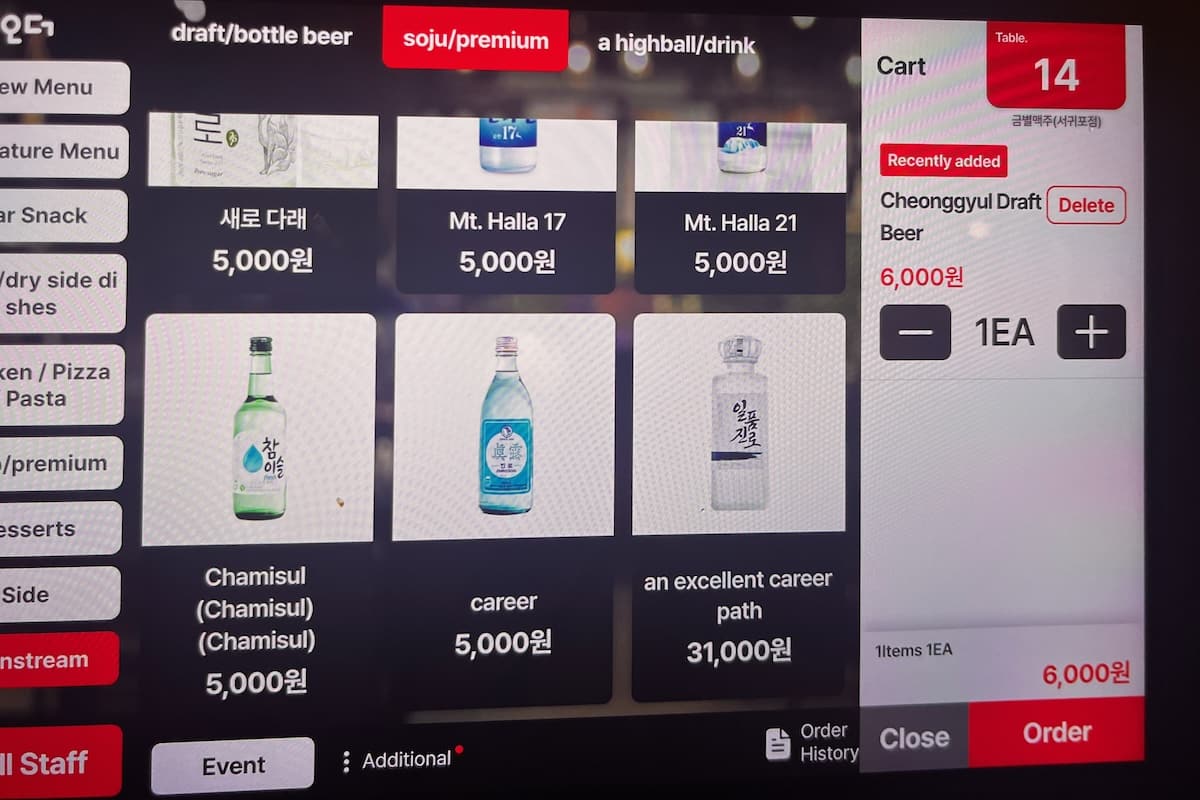
Ordering drinks on an electronic menu in Korea
Self-Service Efficiency
In cafes (even fancy ones) you heat up your own pastry in the microwave, pour your own water from the dispenser and bring your tray and dishes back to the counter. People brush their crumbs with their hand to leave the table neat and clean. Cutlery and napkins will already be at the table; sometimes in a box or in a drawer under the table. Read more on eating in Korea.
Public Safety Alerts
We received notices almost daily on our phones in Korean. We translated the first few and realised they were missing person alerts.
Safety
Korea is a very ordered society with a high safety record. There are handrails in many places up mountains. The footpaths are flat and well maintained. There is a high standard of infrastructure in Korea with many bridges and tunnels as it is so mountainous.
There were few insects when we visited in September and we only saw a few cats on our 2 weeks. The only dogs we saw, not on a leash or in a pram, were 3 from the same family of strays when we hiked Bukhansan Peak in Bukhansan National Park where the ranger chased the dogs when they were hanging around looking fed.
Final Thoughts
The transport infrastructure makes it genuinely easy to move around, the Korean Food is outstanding at every price point, don’t miss out on the Korean BBQ. The balance of ancient and hyper-modern feels completely natural rather than forced. Come with comfortable shoes, a T-Money card and an appetite.
If that’s not enough, you will feel so welcomed by the local people, even in the capital city where they will go out of there way to help you. The genuine warmth of the Koreans was what really stood out for us in our 2 week stay.
Never miss an Adventure!