
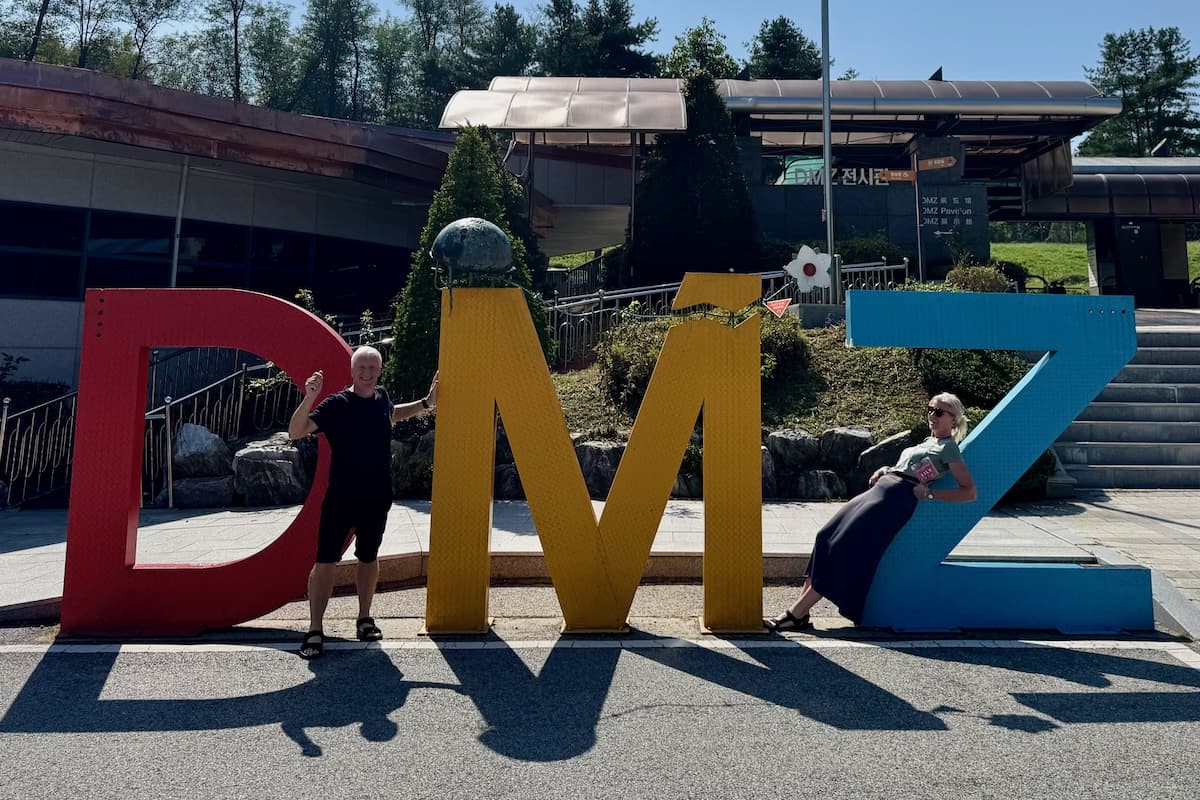
DMZ sign in the demilitarised zone, Korea
DMZ Tour from Seoul - What to Expect
By Gillian Boyd Published 25 March 2026
What to expect on a DMZ tour from Seoul. Learn about it’s importance, history, key features and highlight of meeting a North Korean defector.
What is DMZ?
DMZ stands for the De-militarised Zone which is the zone either side of the border between the Democratic People’s Republic of Korea (DPRK, also known as North Korea) and the Republic of Korea (ROK, also known as South Korea).
The De-militarised Zone varies in size but is on average 2km deep on each side of the border and stretches 250km wide across the country from east to west. This area is controlled by the United Nations.
Access is controlled by the military so may be subject to change and passports are mandatory for identification. Despite it’s name, the area is heavily militarised.
Why Visit DMZ?
The area is an important historical site in understanding the history of the region and current geopolitics. Perhaps because we were born in Northern Ireland, a divided country, and had grown up during the Troubles we were very keen to visit the DMZ as part of our 2 Week Itinerary in South Korea.
Organised Tour
Much as I like to travel independently, it is not possible to visit the DMZ unless on an official tour with a registered guide. There many tours available with different options for which sites to visit.
We booked online with Get Your Guide before travelling to Korea and chose the option to meet a defector. We had read ‘Nothing To Envy’ by Barbara Demick based on interviews with North Korean defectors and so this seemed too good an opportunity to miss.
The tour met at 9:20am at exit 9 of Myeongdong station for the DMZ Tour to the border.
Passports Checked
On the bus, we had to complete our passport details which were given to the military and we had to wait while they were being checked. A soldier boarded the bus. I felt tense. Everyone was quiet and serious as the whole bus could be rejected if the military was unhappy about anything. The soldier left and we were admitted to the DMZ.
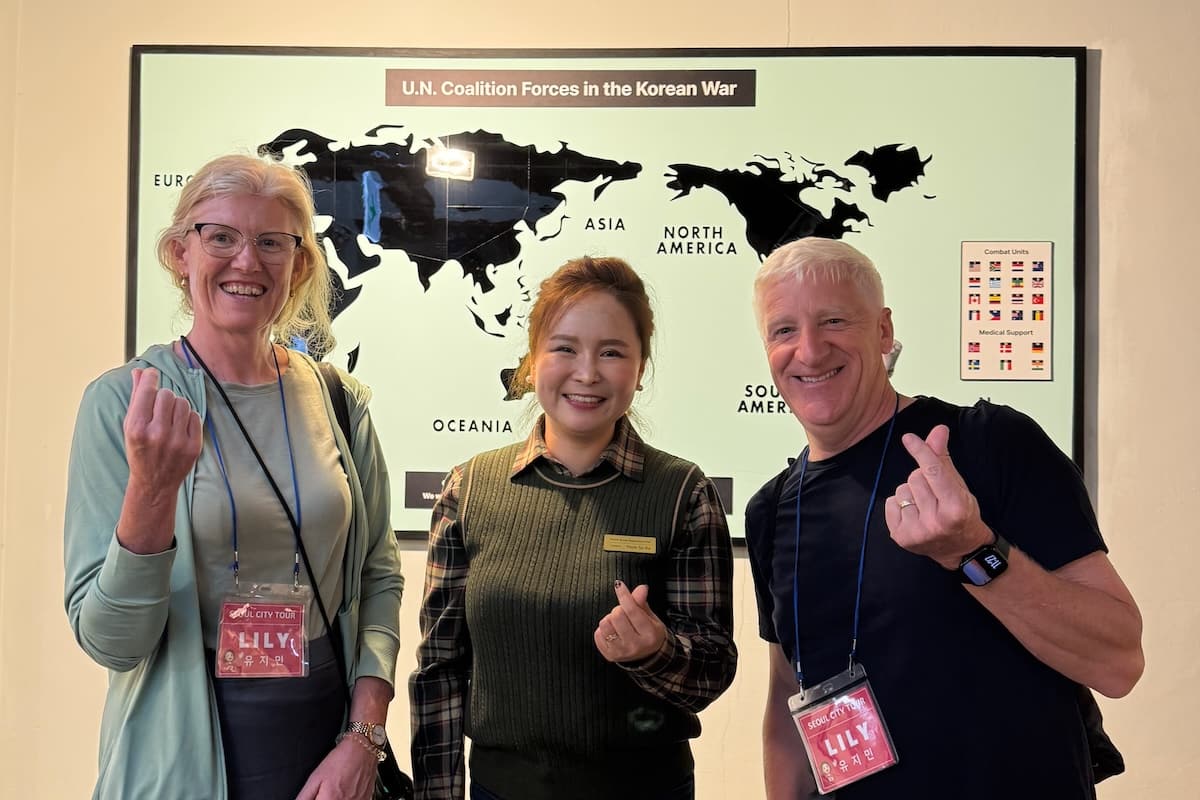
Doing the Korean finger heart gesture together
Meet a North Korean Defector
At the first stop, the Peace Village, we entered the North Korea Experience Hall and spent a few minutes looking at the uniforms and currency on display before the 8-minute video about North Korea began.
Trying to Understand People
Then we met the defector who answered questions from the audience and a guide translated. The audience was large that day, with more than 50 people.
From our tour, a group of Israelis and a group of Germans chose this option. I wondered afterwards if it had resonated with them because they lived in a divided land too.
The more I travel, the more I notice connections between people and realise we have more in common than it first seems.
Her Story
The North Korean defector told us her story. She was a nurse and defected in 2014 after the government stopped paying her salary.
In order to flee North Korea, she paid a broker to help her cross the river alone, then joined 11 other defectors in China. Next she travelled to Laos then Thailand where refugee status was granted after a month.
From escape to confirmed sanctuary took 40 days.
Ask a Question
As part of the experience you are able to ask questions. The answers to some of the questions we posed were harrowing. Feel free to ask whatever you want. You will get an honest answer. The only restriction appeared to be time.
The talk only lasted about 20 minutes and then there was the opportunity to pose for a photo with the defector. I would have liked to have heard more about her life but time was the enemy.
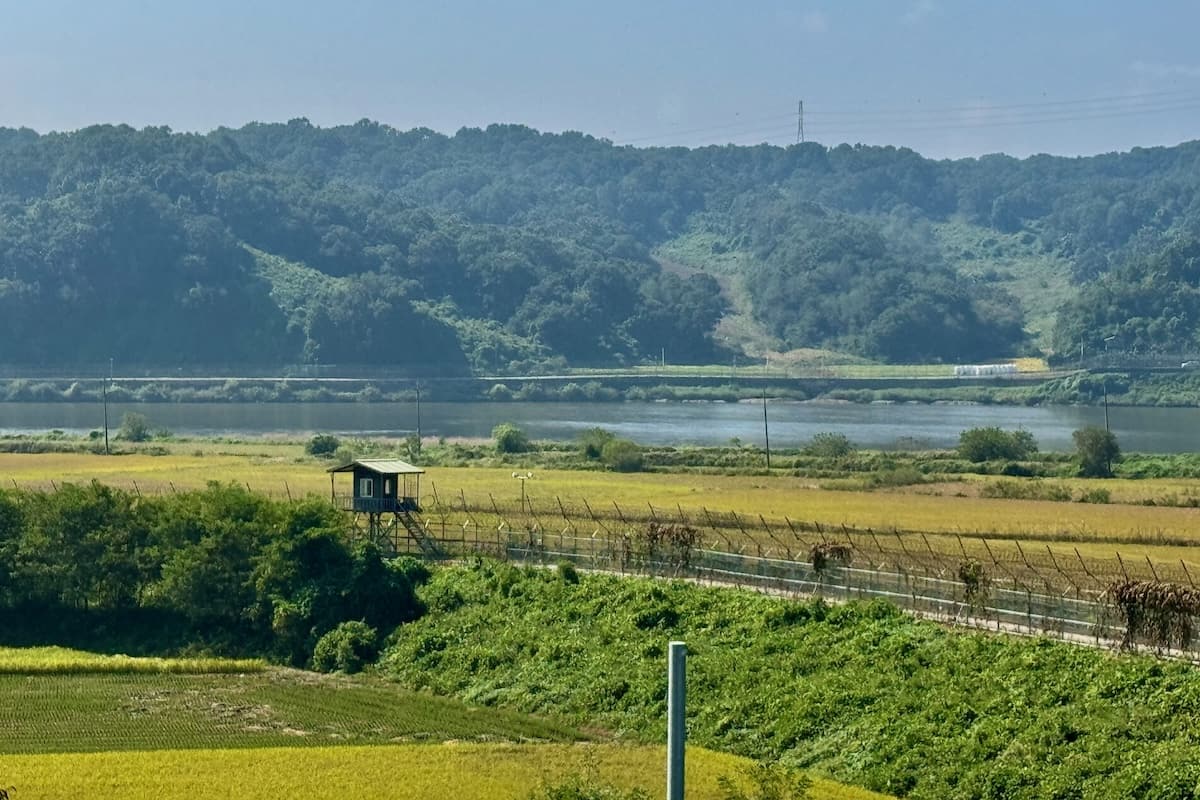
Border of Korea with watch tower and fences on both sides of the river
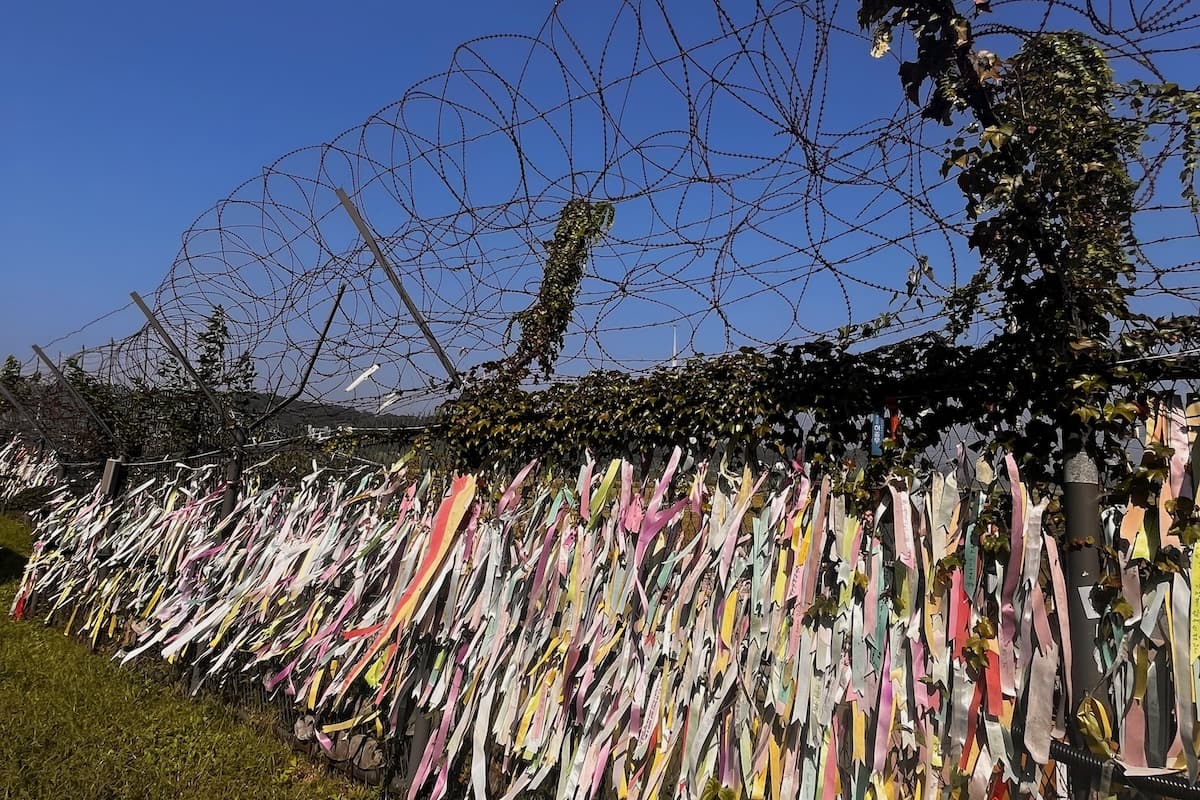
Ribbons with messages tied to barbed wire fence at border of Korea
Peace Village
At the Peace Village there is a shrine on the northern most land of South Korea. This is the closest point Koreans can reach to perform the ancestor rituals. On the big holidays like the Lunar New Year and Thanksgiving, you will see people whose family are in the north, come and perform the ancestor rituals for their family in the north. Our guide’s grandma did this until she died. During our visit to the shrine, a group of women were performing the rituals.
Messages on Ribbon
We saw the barbed wire marking the border and the pieces of faded ribbon with wishes or messages to family in the north tied to the wire. Nearby stood the rusted carcass of a train full of bullet holes.
Bridges and Repaying a Debt
We walked on the wooden boards of the Freedom bridge and saw the Unification Bridge also known as the Cow Bridge. The nickname comes from the founder of Hyundai, Chung Ju-yung, who crossed the Unification Bridge in to North Korea with 1001 cows as a philanthropic gesture to pay back a debt for a cow he had stolen from his father to fund his escape to the South years earlier.
The visit to the Peace Village felt rushed because the allotted time for this stop was eaten into by the time we spent meeting the defector. But we would do it again as meeting the defector was one of our highlights of the tour.
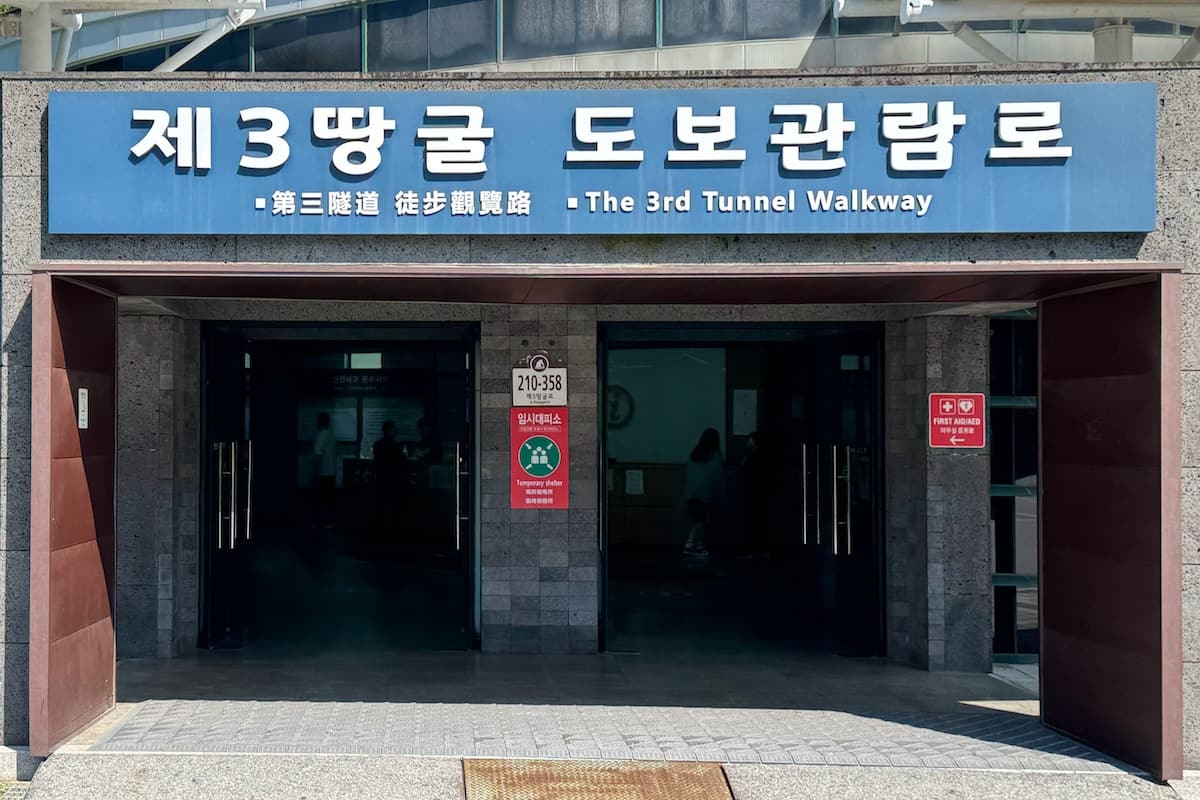
Entrance to the Third Tunnel
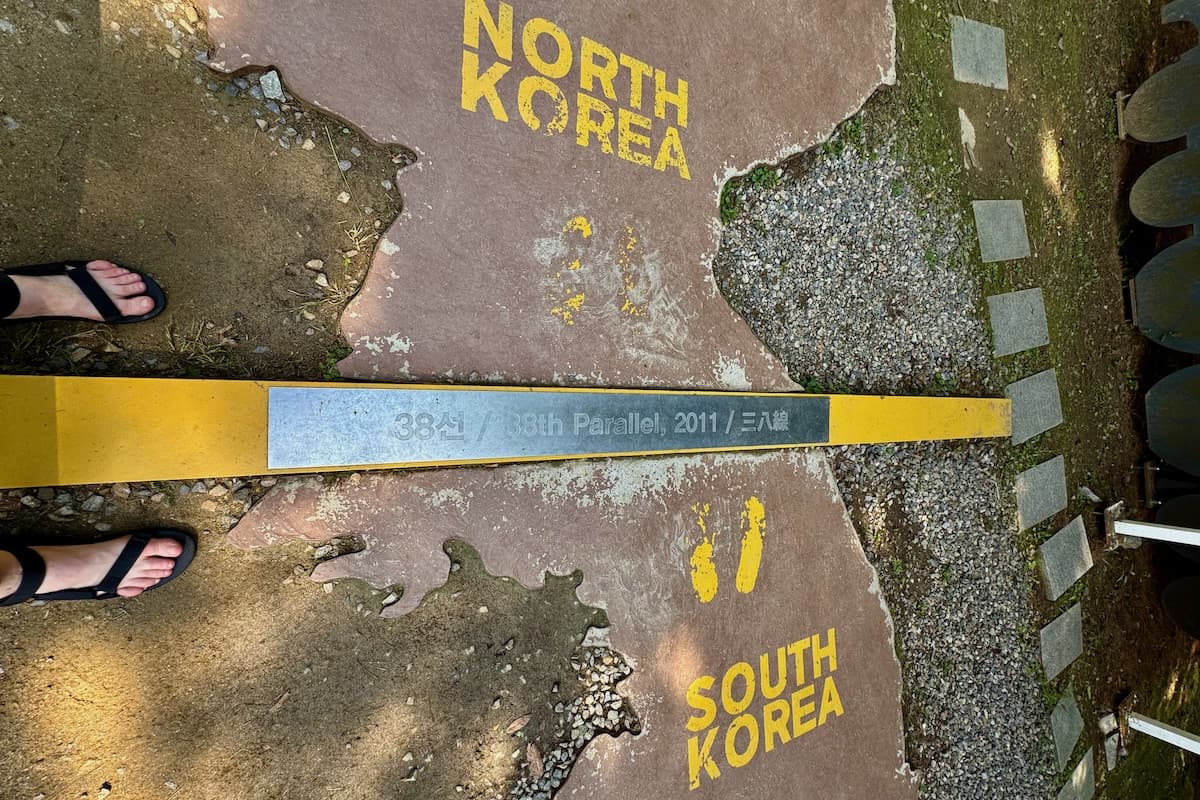
Not quite standing in two countries at once!
The Third Infiltration Tunnel
By 1pm we had gone through the military checkpoint to the 3rd Tunnel. Photography and filming are strictly prohibited inside the tunnel. We watched a different 8-minute video about the formation of North and South Korea. We walked down the steep incline of the interception tunnel and then along the actual tunnel from North Korea. It was hard on the legs and our calves certainly got stretched after yesterday’s hike up Bukhansan Peak.
The tunnel was built large enough for an invasion of 30k troops per day to pass through. It was discovered in 1978, just 44km from Seoul and 435m in to South Korea, after a tip off from a North Korean defector gave the approximate location and a later water explosion caused by North Korean tunnelers enabled an intercept tunnel to find it. It was disguised as a coal shaft.
Disguised as a Coal Mine
It took around 25 mins to walk to the end of the tunnel and see the 3 barricades that sealed the North Korean end. It was the same again to walk back up the steep incline.
We wore hard hats and had to duck to avoid the metal supports. We could see through the different sections and LED lights were on so plants have grown which seemed bizarre. The walls of the tunnel were wet and had black paint to make them look like coal mines. Graham touched the wall and put some black stuff on his face. It looked like the camouflage soldiers use. Yellow paint had been drawn around the dynamite holes.
Spring Water
We drank some of the DMZ spring water available from drinking fountains near the base of the tunnel. Up at the top we posed with the DMZ sign and the 38th parallel line which actually marks the border. It felt very cool to stand with a foot on either side of the 38th parallel and pretend that you are in 2 countries at once. To actually do it, you need to visit the UN Building in the JSA (Joint Security Area), but that was closed to tourists (as it frequently is) when we visited.
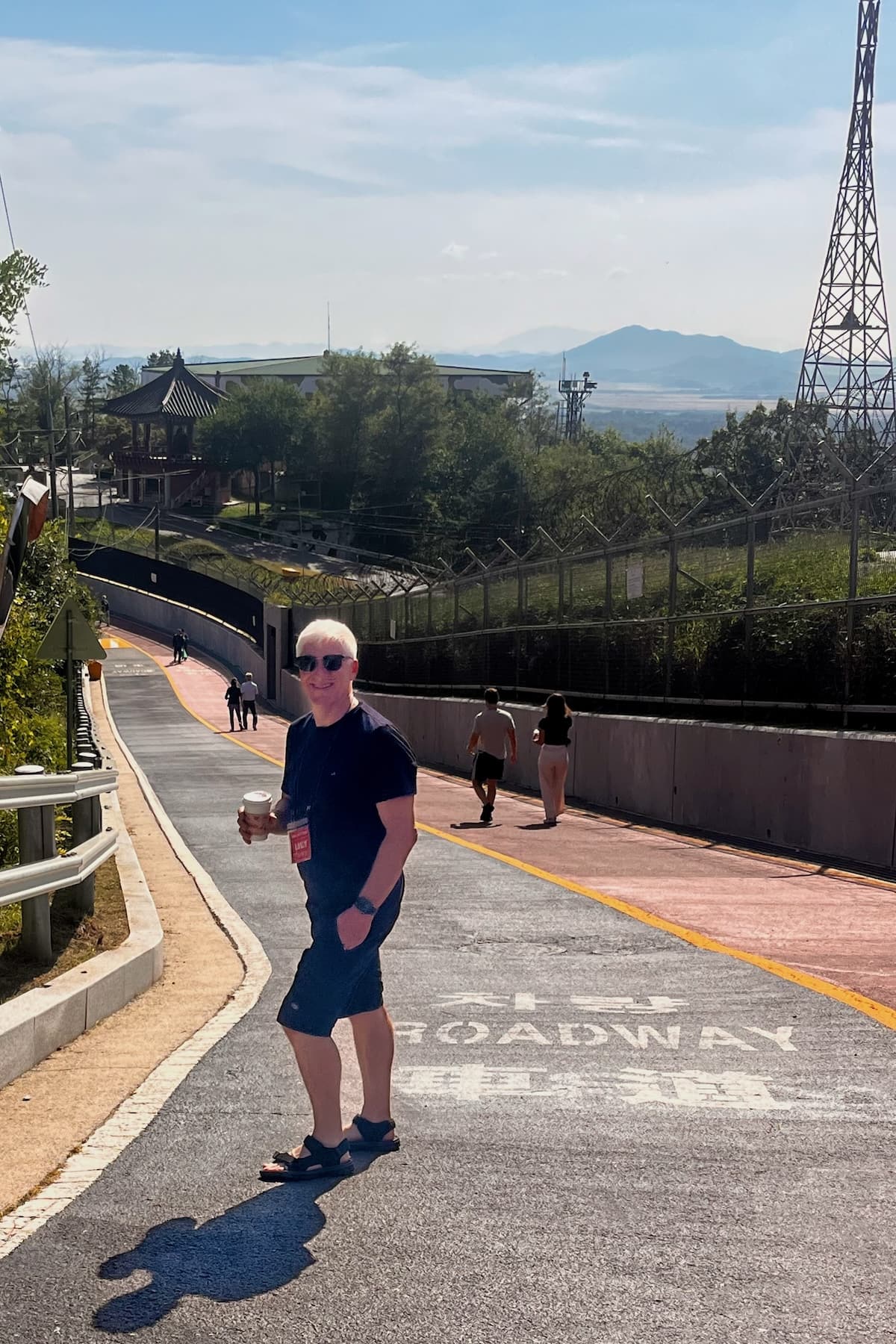
Old Observatory and North Korea in the background
DORA Observatory
It was beautifully clear and sunny by now and through the huge windows and from the rooftop, there were scenic views across the border. From DORA Observatory, we could see North Korea, the boundary, the checkpoints, the Joint Security Area, the United Nations Observation Tower and on the mountain top, the Communications Jamming Tower. No photos though as these were prohibited from the DORA Observatory.
We used the fixed binoculars on the roof and had plenty of time to observe. In fact, we had so much time I went and bought a coffee from the cafe as we hadn’t had time for any lunch at any of the previous stops.
Face off
Our guide told us that the soldiers at Joint Security Area are handsome. Why? Because this is the only place where North and South Korean soldiers are face to face and so the South likes to choose their soldiers to show they are taller, stronger and more handsome.
Also, each side has a huge flag pole. Over a number of years both sides built and rebuilt higher and higher flagpoles to outdo each other. Today, the North Korean flagpole stands higher. Hearing this reminds me of India and Pakistan at the border ceremony near Amritsar who also tried to outdo each other with the size of their flag poles.
Military Service
We were told that in North Korea, mandatory military service is 10 years for men and 8 for women. In the South it is only for men and is currently between 18 and 36 months depending upon role. Women do not have mandatory service.
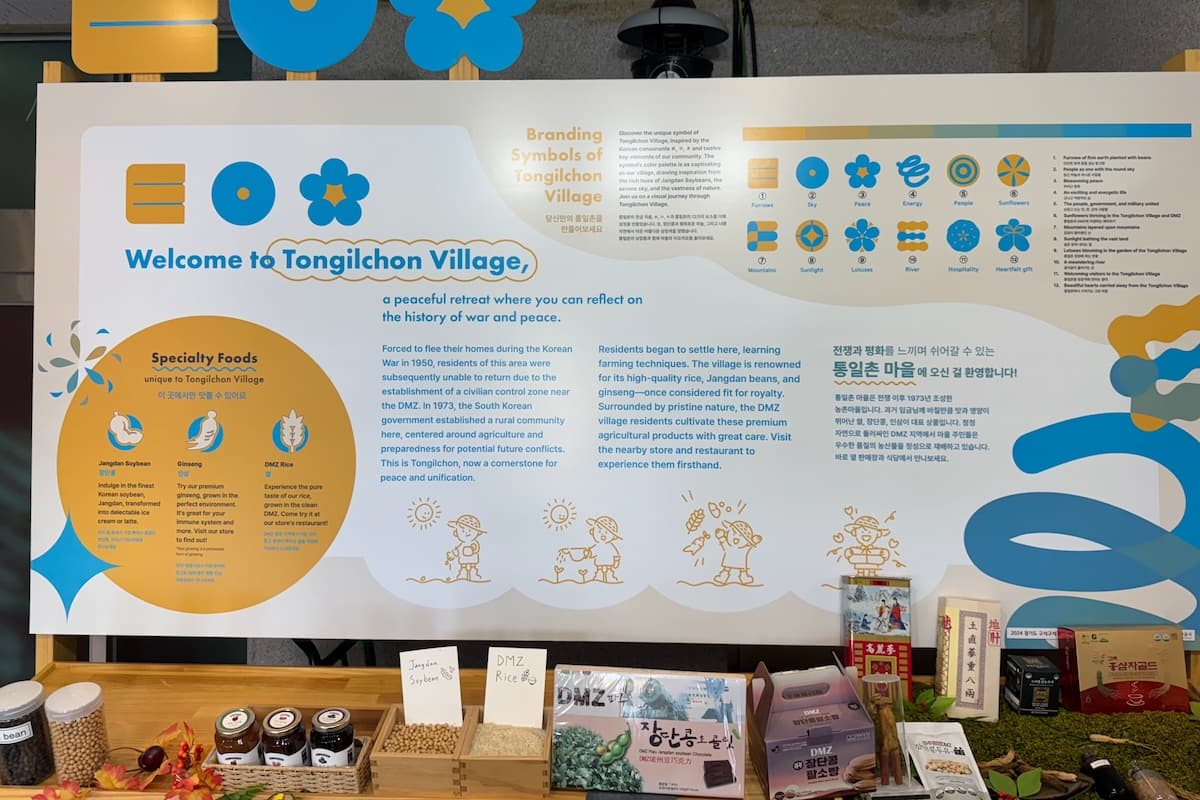
Produce for sale at the Unification Village
Unification Village
By 3pm we were at the final stop, the Unification village. We had a brief stop of 20 mins for photos and to browse the shop of the products from the area including red ginseng, blueberry whiskey (made to North Korean recipe at 38% proof) and snail cream.
We tried some of the free samples. Interestingly, the red ginseng is organically grown as they don’t want chemicals on the land due to the landmines.
Final Thoughts
At 3:15pm we left for the drive back to Seoul in heavy traffic. This tour was considered a half day tour and it was packed. I would have preferred it slightly less rushed especially at the Peace Village as there was lots to see. It was very interesting and one of the highlights of my 2 week itinerary in South Korea.
Never miss an Adventure!