
Free Walking Tour in Mexico City
By Gillian Boyd Published 4 April 2026
We booked the historical Free Walking Tour in the Centro Historico of Mexico City with GuruWalk.com and met outside the Metropolitan Cathedral, a popular meeting point for many of the free walking tours.
Remember, the free walking tour is only free in the sense that there is no fixed price. You are expected to tip. US$10 per person was suggested by the guide. The tour lasted about 2.5 hours.
We booked the tour for our first day of our ultimate 4 day itinerary of Mexico City to get an early feel for the city and its culture.
Tenochtitlan
Mexico City was built on an island on Lake Texcoco around 1325 C.E. The original city, called Tenochtitlan, was the capital of the Aztec or Mexica people who spoke a language that looks very different to Spanish. It was a city of great wealth obtained through the spoils of tribute from conquered regions.
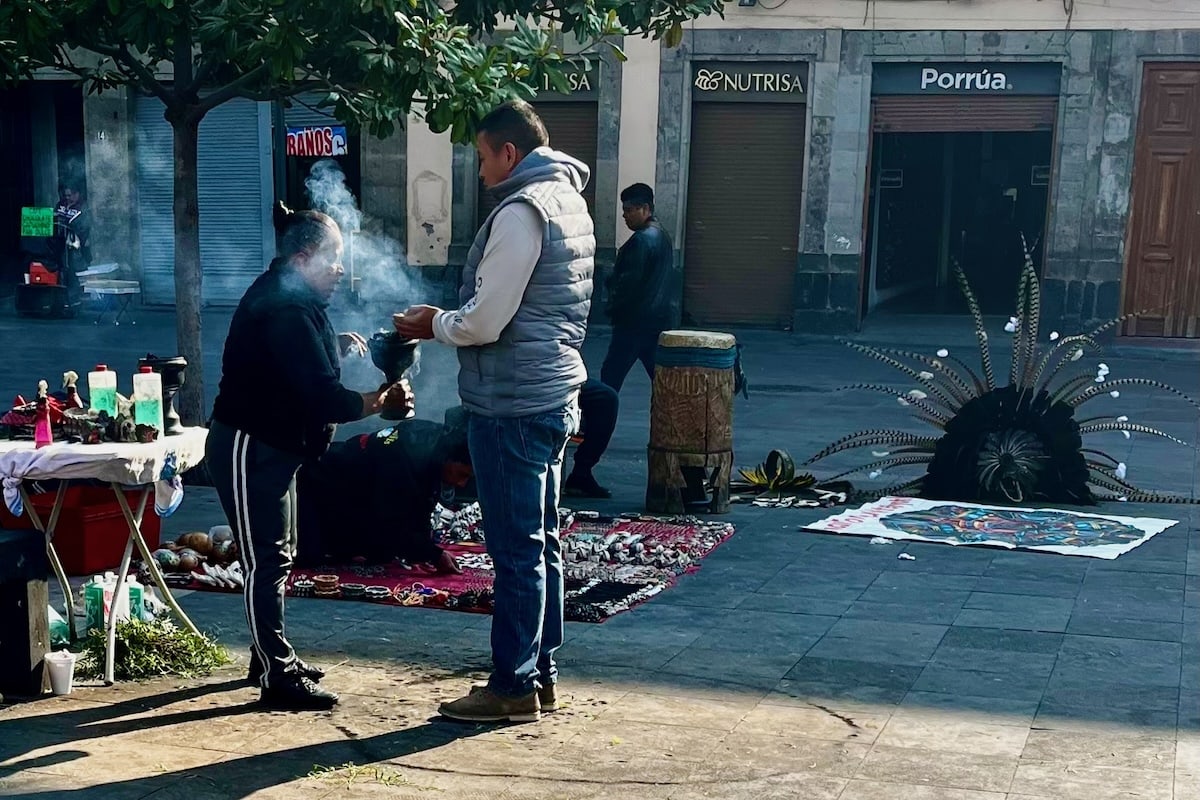
The ancient and modern live side by side in Mexico
Ritual
Passing the Catedral Metropolitana de la Ciudad de México (Metropolitan Cathedral of Mexico City) the air was full of the smell of incense, the sounds of drums beating and chanting by people in full indigenous ceremonial clothing. As we walked by, we saw a ritual being performed, most likely a cleansing ceremony. A man solemnly stood still with his head bowed and hands clasped together in prayer at his chest. A woman lit a bunch of herbs, chanted and wafted the smoke all around his body. The ancient and the modern live side by side in Mexico.
Sinking
Like Venice, Tenochtitlan had a system of canals for streets but the lake was drained when the Spanish conquered the Aztecs in 1521. The Spanish knocked down the religious buildings and used the stone to create the colonial buildings and palaces currently surrounding the Centro Historico. But now the city is sinking at a rate of 7cm per year and the buildings are higgledy-piggledy on the same street as they sink at different rates.
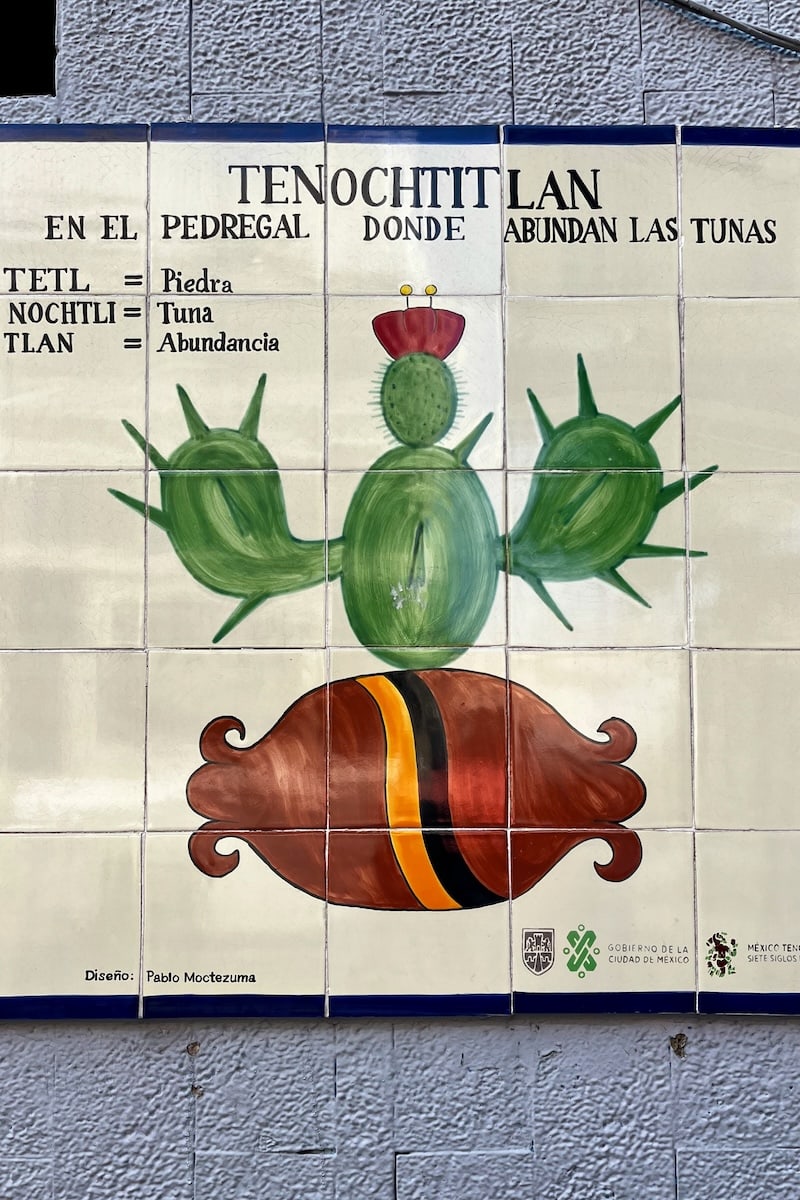
Icon of Mexico painted on tiles in Mexico City
Temple Mayor
In 1978 the electric company were digging two meters down and struck a large pre-Hispanic disc. This gave the necessary push to uncover The Temple Mayor which is dedicated to two different gods -Tlaloc, the god of rain and Huitzilopochtli, the god of war.
Icon of Mexico
The Temple Mayor is situated on the spot where Huitzilopochtli gave the sign that the people had found the promised land. This sign was an eagle holding a snake in its mouth perched on top of a cactus. We saw this icon many times in Mexico.
Each Aztec Emperor built a new temple on top of the existing one and so far, six temples have been uncovered with the archaeologists still excavating and making more discoveries today.
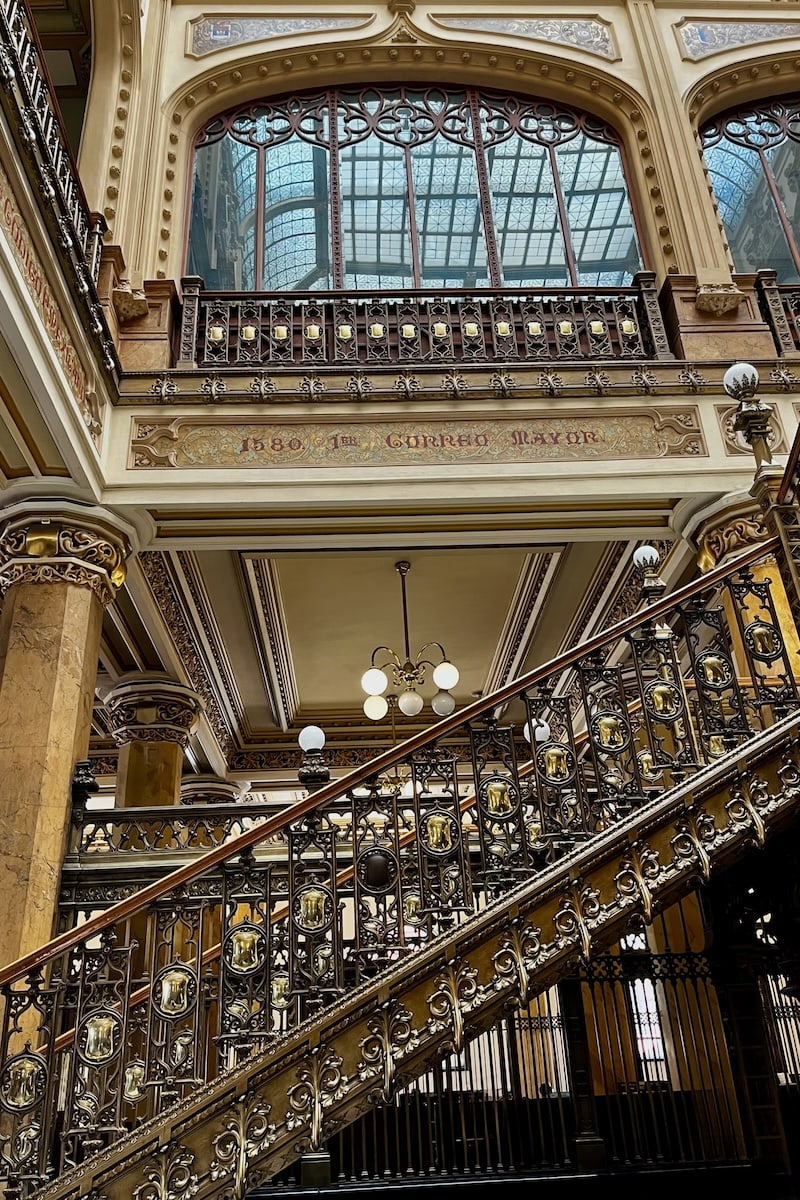
Ornate staircase in the Postal Palace of Mexico City
Palacio de Correos de México
Built in 1902 by the Italian Adamo Boari and Mexican Gonzalo Garita, the Postal Palace is very ornate and grand. It has an eclectic mix of European architectural styles and Mexican materials including stone from Puebla.
There are gargoles, marble ornaments, elaborate plaster work and bronzes cast in Italy. The Postal Palace was damaged in the 1985 earthquake and later restored. It now has a steel frame and a foundation that was built on an enormous grid of steel beams to withstand subsidence and earthquakes.
Earthquakes
While we sampled some local fruits and food, our guide told us what to do if there was an earthquake – get out of the building into the street or if that is not possible then stand in the frame of a doorway.
The west coast of Mexico is situated on the ‘Ring of Fire’ and has trembles almost every day. Mexico City is empty on 19 September every year. Why? Because at roughly the same time on 19 September in 2022, 2017 and 1985, Mexico City had devasting earthquakes. Coincidence or a pattern? Now there is a topic that could become one of my favourite podcasts.
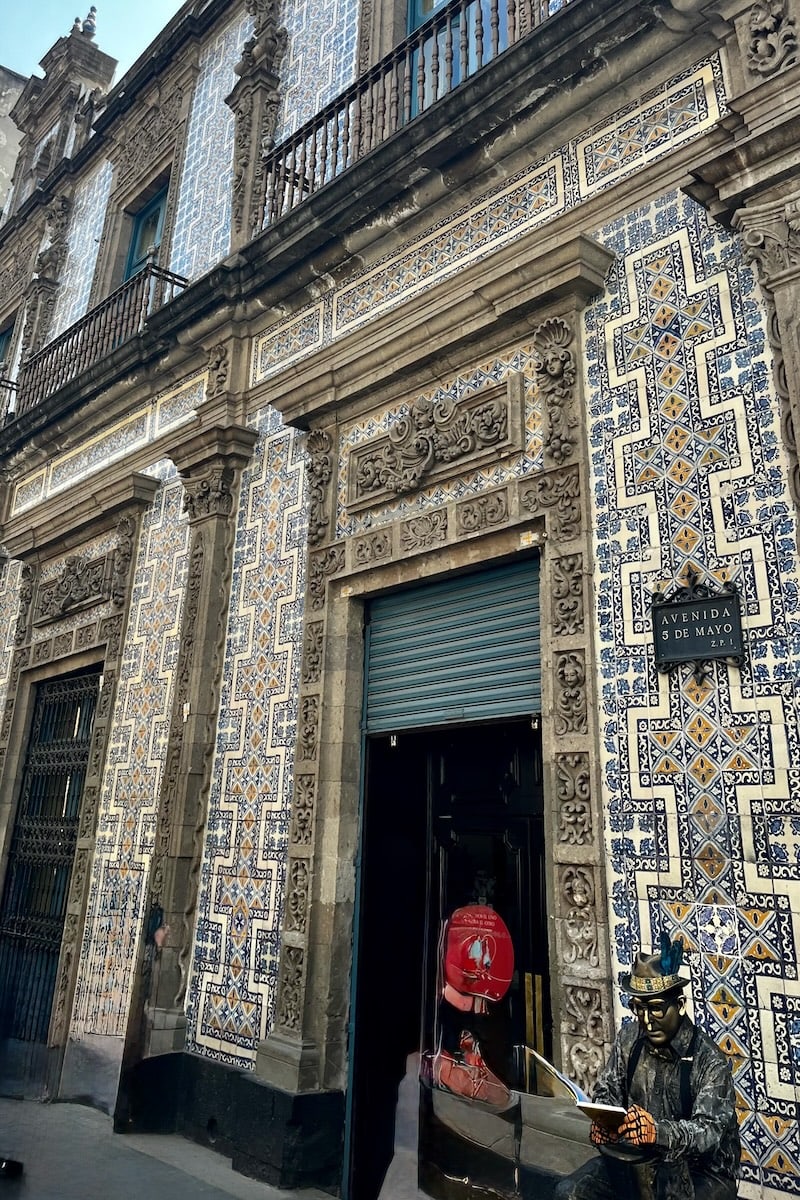
Blue and White Tiles on La Casa de Los Azulejos
La Casa de Los Azuejos
The free walking took us to the Avenida 5 de Mayo which proved to be the first of many throughout Mexico. Just like the UK, Mexico has a core number of street names that appear in every city. The date is of significance, particularly in the state of Puebla, as it marks the victory of the poorly equipped Mexican forces over a much larger elite French army and so celebrates the resilience of Mexico in a show of national unity.
We continued past the Casa de Los Azulejos (House of Tiles) an 18th century Baroque palace with the exterior covered in blue and white mosaics.
Palacio de Bellas Artes
The grand finale was the Palacio de Bellas Artes (Palace of Fine Arts), a beautiful pale neoclassical and art nouveau building with a domed roof graduating from orange to yellow like a tequila sunrise cocktail, where the tour concluded. Hopefully there is no scaffolding around the building when you visit.
Final Thoughts
On this tour we learnt so much that I have only mentioned part of it here, including how Euro-centric our education has been. The architecture revealed the rich culture of Mexico with the ancient and modern living side by side. The guide bought it all to life with her stories.
By the time the tour ended, jet lag meant my thoughts had wandered to finding a seat in a cocktail bar, rather than going inside to see the art at the Palacio de Belles Artes.
Going on this free walking tour was the start of a new custom for us, as we now seek out such walks in most cities we visit. Free walking tours are a great way to get your bearings very quickly and understand a place. Just don’t forget to tip the guide.